Structural Corrections That Extend a Tree's Useful Life
Tree pruning in Elberfeld for diseased wood, weak crotches, and crown weight imbalance
Selective pruning removes diseased wood, corrects shape, and encourages strong branch angles that resist splitting. Latham's Tree Service LLC performs tree pruning in Elberfeld for mature hardwoods that have developed the structural problems common to established timber in this region—included bark at branch unions, dead interior limbs, and co-dominant stems that compete for dominance without either establishing clear structural priority. Left unaddressed, these conditions tend to progress until a failure event settles the question at the worst possible time.
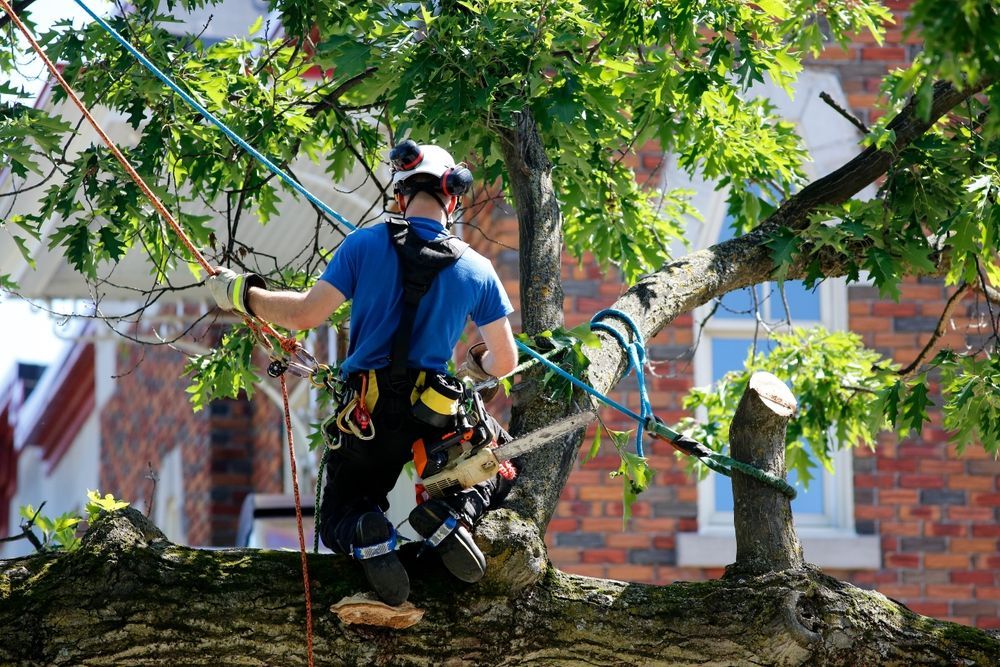
Work follows ISA standards for proper cut placement, which means each cut is made just outside the branch collar to support the tree's natural wound closure response. The crew removes dead and diseased limbs first, then addresses crossing branches and eliminates weak V-crotches where included bark has formed. Crown shape is adjusted to balance weight distribution across the remaining structure. Debris is chipped or removed based on your preference, leaving the site clean when the crew leaves.
Schedule an evaluation to walk the trees with the crew and identify which structural issues are active concerns versus longer-term maintenance items.
How Pruning Addresses the Failure Patterns Common in This Region
Mature hardwoods in the Tennyson and Victoria Woods areas—and across river-bottom properties generally—develop included bark at branch unions over decades of close-competition growth. Included bark occurs when two stems grow so tightly together that bark becomes embedded between them rather than forming clean, ridged collars. That bark layer prevents the wood from bonding across the union, creating a structural fault line that can split under load. Identifying and correcting those unions while the stems are still manageable in diameter is the most effective intervention available.
After pruning is complete, the crown reflects a more deliberate structure: fewer competing leaders, cleaner branching angles, and no dead wood accumulating in the interior where it can host fungal decay or attract wood-boring insects. Latham's Tree Service LLC works through the crown methodically so that weight reduction and structural correction happen together rather than leaving the tree unbalanced after selective cuts.
Pruning doesn't restore a tree that has advanced structural decay at the root flare or main trunk—those conditions require an honest removal conversation. What pruning does address is crown structure, attachment points, and deadwood load, which are correctable with proper sequenced work on trees that are otherwise sound at the base.
Questions Before Starting Your Pruning Project
The following questions address how pruning decisions are made, what ISA-standard cut placement means in practice, and what you'll observe in the tree after the work is complete.
What is included bark and why does it matter for pruning decisions?
Included bark forms when two co-dominant stems grow tightly together and bark becomes trapped between them instead of forming a structural bond. The union lacks wood-to-wood attachment, making it far more likely to split under load than a properly formed branch collar.
How does the crew sequence pruning cuts to avoid destabilizing the crown?
Dead and diseased wood comes out first since its removal doesn't shift load. Structural corrections—removing co-dominant stems or crossing branches—follow, with the crew reassessing crown balance between major cuts to confirm the remaining structure carries weight evenly.
What does proper cut placement look like on a pruned hardwood?
The cut is made just outside the branch collar at a slight angle, leaving no stub and not cutting flush with the trunk. The collar tissue is preserved so the tree can generate callous wood that closes over the wound progressively.
How do you determine whether a sick or weakened tree is a good candidate for pruning in Elberfeld?
Trees with localized branch dieback, disease confined to specific limbs, or mechanical damage in the crown can often benefit from corrective pruning. Trees with basal decay, significant trunk cavities, or systemic fungal infection typically aren't candidates where pruning alone will extend function.
What maintenance should follow a pruning session in subsequent years?
Check the crown annually for new deadwood development, watch for epicormic shoots growing from pruning sites—they indicate the tree is compensating for removed canopy—and schedule follow-up work if co-dominant stems that were left in place develop included bark as they mature.
Latham's Tree Service LLC also performs tree pruning in Evansville, Newburgh, Haubstadt, Boonville, and Darmstadt. Call (812) 306-9696 to walk through the specific hardwoods on your property and determine which structural concerns are the right priority for this season's work.