
Stumps Removed Without Years of Waiting
Stump grinding service in Elberfeld for properties where cut stumps are blocking replanting, construction, or cleared land use
Rural properties in and around Elberfeld—particularly those with mature hardwood canopy or river-bottom timber stands—regularly end up with multiple stumps scattered across cleared ground after trees come down. A stump left in place does not open the land for new use; it ties up that ground for years while the root mass rots slowly from below. LATHAM'S TREE SERVICE LLC operates stump grinding service in Elberfeld that removes the stump and accessible root material below grade, making the area usable immediately rather than waiting on natural decay.
The crew brings a stump grinder to the site and works the stump down to 8 to 12 inches below grade, along with the root material that the grinder can reach from the surface. The resulting wood chips and mulch stay on site unless you request removal. Grinding to that depth is what separates a properly finished job from a surface reduction—a stump cut flush with the ground will still heave, re-sprout from the root collar on many hardwood species, and prevent any meaningful use of the space above it. Going below grade eliminates those problems and allows the area to be replanted, graded, or built over.
Schedule a site visit with LATHAM'S TREE SERVICE LLC to assess the stump locations and confirm the approach before grinding begins.
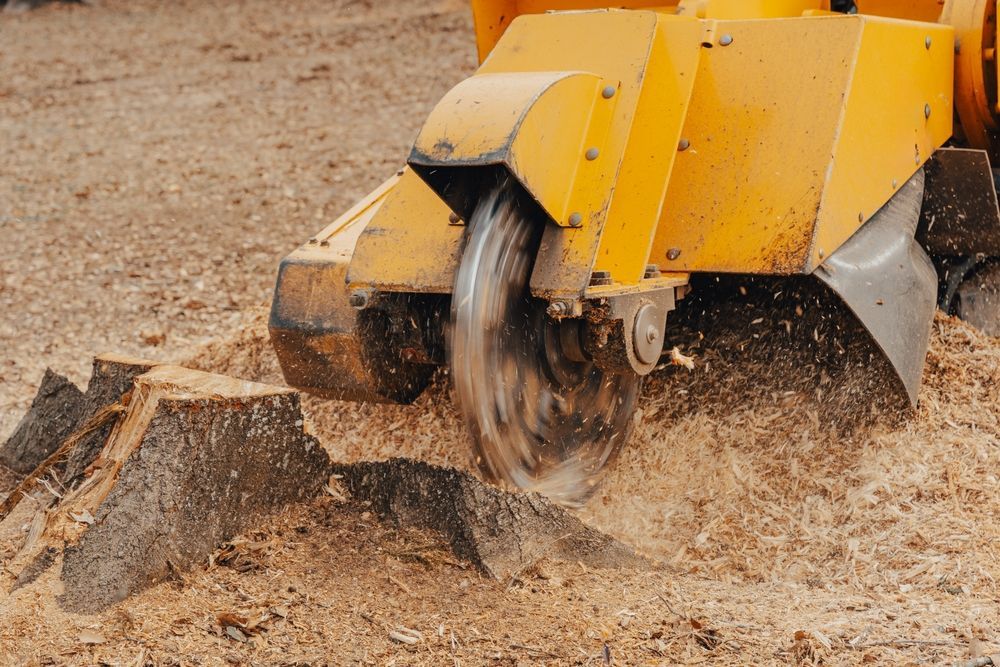
How Stump Grinding Opens Ground for Immediate Use
Stump grinding works by mechanically reducing the stump and root crown to mulch in place—no excavation, no chemical treatment waiting period, no heavy equipment tearing up surrounding ground to pull a root ball. The grinder passes over the stump repeatedly, working the cutting wheel through the wood in layers until the material is gone and the resulting chips fill the void left below grade. Because the process is contained to the stump footprint, adjacent turf, landscaping, and hardscape stay largely undisturbed.
Once grinding is complete, the area above the stump becomes workable. The mulch left in the void will settle and compress over the following weeks as it breaks down; if you plan to sod, seed, or pour concrete over the area, that settling behavior matters and the mulch can be raked out and replaced with soil at your direction. What the space will no longer do is re-sprout—hardwood species that reliably send up new growth from a cut stump stop doing so once the root collar is ground out below grade.
Lot clearing scenarios with multiple stumps are handled in sequence across the property rather than as separate mobilizations, which matters for efficiency when Elberfeld properties have had significant timber removed across a larger footprint. The size and species of each stump affects how long grinding takes at each location—dense hardwoods like oak and hickory, common in the river-bottom canopy of this region, take more passes than softer or smaller-diameter stumps, and that affects how the crew sequences the work across a multi-stump site.
What Property Owners Ask About Stump Grinding
The questions below cover the mechanics of stump grinding and what to expect from the process, particularly for properties with mature hardwood stumps or multiple stumps from lot clearing work.
How far below ground does stump grinding go?
The grinder works the stump and root crown down to approximately 8 to 12 inches below grade, which is sufficient depth for replanting, grading, or most construction use above the area.
What happens to the wood chips left after stump grinding?
The chips fill the void left by the removed stump and can be left in place to settle, spread across the yard, or raked out and replaced with topsoil if you plan to sod or seed over the area.
Why does grinding work better than pulling a stump out?
Pulling a stump requires excavating the full root ball, which disturbs a large area of surrounding ground; grinding removes the stump and root collar in place without tearing up adjacent turf or requiring heavy extraction equipment.
Will the stump re-sprout after grinding?
Hardwood species that send up new growth from the root collar after cutting will not re-sprout once the root crown is ground below grade, because the tissue that produces that growth is removed during the process.
How does the number of stumps on a property affect how the work is done?
Multiple stumps are sequenced in a single mobilization rather than handled as separate visits; stump diameter, species density, and site access at each location determine the order and time spent at each one.
LATHAM'S TREE SERVICE LLC also provides stump grinding in Evansville, Newburgh, Haubstadt, Boonville, and Darmstadt. To discuss the stumps on your property and confirm the right approach for the site conditions, call LATHAM'S TREE SERVICE LLC at (812) 306-9696.